
A child’s bite doesn’t drift out of alignment overnight. It shifts a millimeter at a time, hidden behind everyday habits like thumb sucking, mouth breathing, or a tooth that came in slightly crooked, until years later a parent is told their teenager needs jaw surgery instead of a simple appliance. Early orthodontic issues in children are rarely dramatic at first, and that is why they are missed.
At Dentistry For Children, we screen for these patterns at nearly every checkup, because the earlier they’re caught, the fewer options get taken off the table.
This blog breaks down the specific signs that signal a developing bite problem, the ages when jaw growth is most responsive to guidance, and what actually happens during a screening. You’ll also learn what kind of damage some habits do that is long-lasting, and what the general outcome is when left to their own devices.
Why Early Orthodontic Detection Matters
The first permanent molars erupt at about age six, and the instant they erupt, they lock in what is called the posterior occlusion, the back-of-the-mouth bite relationship upon which everything else is built. A pediatric orthodontic evaluation timed to this window lets a dentist see how that relationship is forming while the jaw bones are still soft and pliable. Wait until the jaw is done growing, and the same correction that required removable appliances may require extractions, surgery, or both. That difference is the entire argument for orthodontic treatment for growing children starting early rather than late.
Common Early Signs Parents Should Watch For
Some signs are obvious at first glance; others only become apparent once you know what to look for. Here are the five patterns to watch out for.
1. Crowded or Overlapping Teeth
Crowded teeth in kids show up when the jaw doesn’t have enough length for incoming permanent teeth, and it rarely improves on its own. As each new tooth comes in, it pushes against the ones around it, and so a slight overlap at age seven can turn into crooked, rotated teeth by age eleven more challenging to clean and more susceptible to cavities
2. Bite Problems (Overbite, Underbite, Crossbite & Open Bite)
| Bite Type | What It Looks Like | Why It Matters |
| Overbite in children | Upper teeth extend far over lower teeth | Can strain the jaw joint and increase wear |
| Underbite symptoms | Lower jaw juts forward past the upper teeth | May affect chewing and facial profile |
| Crossbite treatment | Some upper teeth sit inside the lower teeth | Can cause uneven jaw growth if untreated |
| Open bite in children | Front teeth don’t touch when the mouth closes | Often linked to speech and chewing difficulty |
A crossbite left alone doesn’t stay put. It can quietly reshape which side of the jaw grows faster.
3. Early or Delayed Loss of Baby Teeth
Baby teeth keep proper space for the permanent teeth behind them, so timing along the baby teeth eruption timeline matters more than most parents realize. When a tooth is lost years too soon, the teeth around it drift into the space, blocking the space a permanent tooth needs to erupt, often sideways or impacted.
4. Mouth Breathing and Thumb Sucking
Thumb sucking and orthodontics are directly linked: research on sucking habits shows that duration and intensity, not the habit itself, predict damage, and sucking that exceeds roughly six hours a day once permanent teeth are erupting is strongly associated with an open bite and a narrowed palate. Most children give up the habit between the ages of two and four without any problems, but by the age of eight only about 4% of children continue to suck a thumb. Thus, a habit that is present at seven or eight years of age is already outside the range of normal. Chronic mouth breathing dental development concerns work differently but end up in a similar place: breathing through the mouth removes the tongue’s resting support against the roof of the mouth, and without it the upper jaw narrows over time.
5. Difficulty Chewing, Biting, or Speaking
A lisp that doesn’t resolve, or a child who avoids chewy foods, often points to a bite issue affecting permanent teeth alignment as adult teeth settle. These functional signs are usually seen after the structural problem has already been established, not before.
Orthodontic Milestones by Age
Jaw development moves through distinct stages, and each one calls for a different kind of attention.
1. Ages 5–7: First Evaluation
The American Association of Orthodontists recommends an orthodontic checkup at age 7 for every child, whether or not the teeth look straight. This is when the first molars and incisors have erupted, and a dentist has enough of the permanent bite to detect anterior or posterior crossbites, protrusion, or ectopic eruption. At this point, an early braces evaluation is a baseline, not a treatment plan.
2. Ages 8–10: Monitoring Jaw Growth
With most baby molars still in place and the jaw actively lengthening, this stage is about tracking jaw growth and tooth development over time rather than reacting to a single visit. Small discrepancies that were only worth watching at age seven often become clearer here.
3. Ages 11–13: Preparing for Comprehensive Treatment
The growth spurt of puberty accelerates changes in the jaws further, so that most permanent teeth have erupted by this age, and comprehensive treatment planning is a realistic option if required.
What Happens During an Early Orthodontic Assessment?
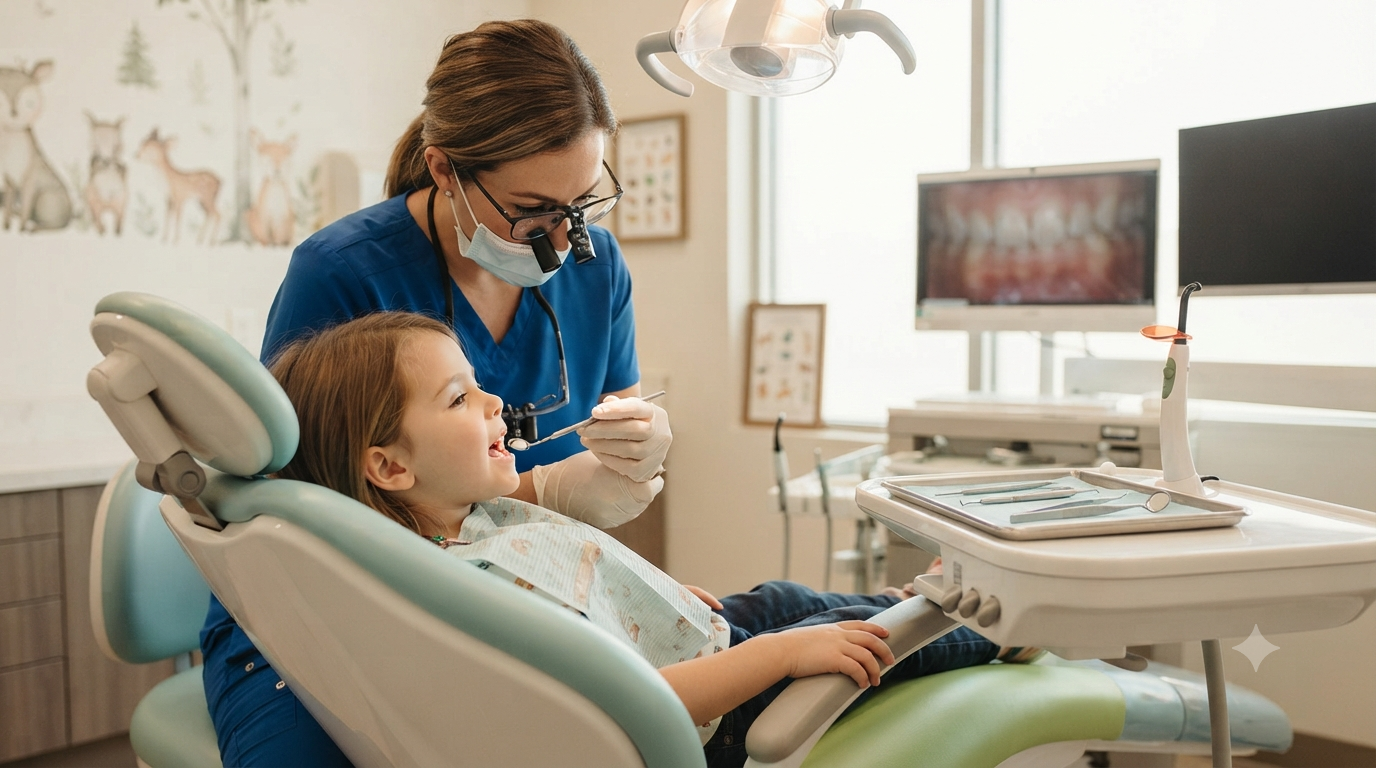
Our pediatric dentists check a child’s bite alignment, spacing, and jaw symmetry as part of a routine checkup, looking specifically at how the upper and lower teeth meet and whether there’s room for the teeth still coming in. If a pattern like a crossbite or a lingering thumb-sucking habit shows up, we’ll recommend a trusted orthodontist so treatment starts at the right time, not after the window has closed.
Can Early Treatment Prevent Braces Later?
Interceptive orthodontics, sometimes called Phase 1 orthodontic treatment, is used when baby and permanent teeth are present at the same time, guiding jaw growth while it’s still responsive. It doesn’t guarantee a child will never need braces. What it does is reduce the size of the problem an orthodontist is solving later, often avoiding extractions or more invasive correction.
Tips for Parents to Support Healthy Dental Development
- Address thumb sucking before age four; past that point, palate narrowing becomes harder to reverse on its own.
- Ask about snoring or an always-open mouth, both signs of chronic mouth breathing.
- Keep every scheduled checkup, since jaw problems are tracked over years, not caught in one visit.
- Offer firmer, chewier foods to encourage natural jaw development.
- Flag any speech changes or chewing difficulty right away rather than waiting to see if it resolves.
Start Your Child on the Right Path with Early Orthodontic Care
Children’s orthodontic care is built on consistency. One visit rarely tells the whole story, but a pattern over several visits almost always does, which is why the signs above are worth taking seriously the first time they appear.
Building a Foundation for a Healthier Smile
Catching crowding, bite misalignment, or habits like thumb sucking and mouth breathing early gives a growing jaw the best chance to develop correctly, and the age-7 evaluation window exists precisely because that’s when the clearest picture is available. Left alone, these issues rarely stay the same size; they tend to compound as the jaw continues to grow.
At Dentistry For Children, our pediatric dentists build this kind of tracking into routine visits and recommend a trusted orthodontist the moment a pattern needs closer attention. We see families from Bremerton, Port Orchard, Silverdale, Poulsbo, Bainbridge Island, Kingston, Belfair, Port Townsend, Port Hadlock, Port Ludlow, Seabeck, Hansville, and Gig Harbor at our two Kitsap locations, and early screening is part of nearly every child’s checkup with us.
If you’ve noticed any of the signs covered here, the right move is a checkup now, not a wait-and-see approach. (360) 377-3844